Species of the Week: The Clouded Sulphur

Photo by Nata Culhane

This week’s #SpeciesOfTheWeek is the Clouded Sulphur (Colias philodice).  The Clouded Sulphur is a species of meadow butterfly that gets its name from its colour which is similar to that of solid sulphur. The life cycle of the Clouded Sulphur starts when a female lays eggs on clover and similar legumes. Initially cream-coloured, the eggs change colour to red within a couple of days. A few days to a week after the eggs are laid, green caterpillars emerge and begin to eat. They moult several times as they get larger with hibernation occurring in the third or fourth instar in colder climates. When a non-overwintering generation is produced, the pupa requires 10 days in a cocoon in order to emerge as a full-grown butterfly. The Clouded Sulphur is widespread throughout North America, with the exception of Labrador, northern Quebec and the Arctic Regions of Canada.  It is commonly found in lawns and fields, where it drinks from different flowers such as clovers and milkweed. Predators of the Clouded Sulphur include birds, dragonflies, frogs and mantids.

Posted in Friends of Murphys Point, Murphys Point, Murphys Point Provincial Park, Species of the Week | Leave a comment

Species of the week: The Snowshoe Hare

This week’s #SpeciesOfTheWeek is the Snowshoe Hare (Lepus americanus)! Named for their large, snowshoe-esque paws, Snowshoe Hares are well-adapted to walking on snow during winter. Their fur also changes colour in winter to blend in better with the snow – but the tips of their ears are always black, a helpful identification tip. It takes them about 10 weeks to fully change colour, so we could be seeing cute mid-change hares like the one in the second image very soon! You might wonder why they’re called hares and not rabbits – hares are much bigger than rabbits, and flee when threatened, while rabbits will often just freeze. Snowshoe Hares are omnivores, consuming mostly plants in the summer months and twigs, branches and bark in the winter, occasionally switching it up with a small mammal (like a vole or a mouse). They breed multiple times a year, and females can have up to 3 litters per summer, each of which can include up to 13 babies! Unlike rabbits, which are helpless at birth, hares are born with their eyes open, fully furred and ready to run. They can live up to 6 years, but due to predation and disease, few live more than 2-4 years. Snowshoe Hares can be found almost everywhere in Canada, and at Murphys Point, we often see them near the Lally Homestead and along the Silver Queen Mine Trail. 

Posted in Friends of Murphys Point, Murphys Point, Murphys Point Provincial Park, Species of the Week | Leave a comment

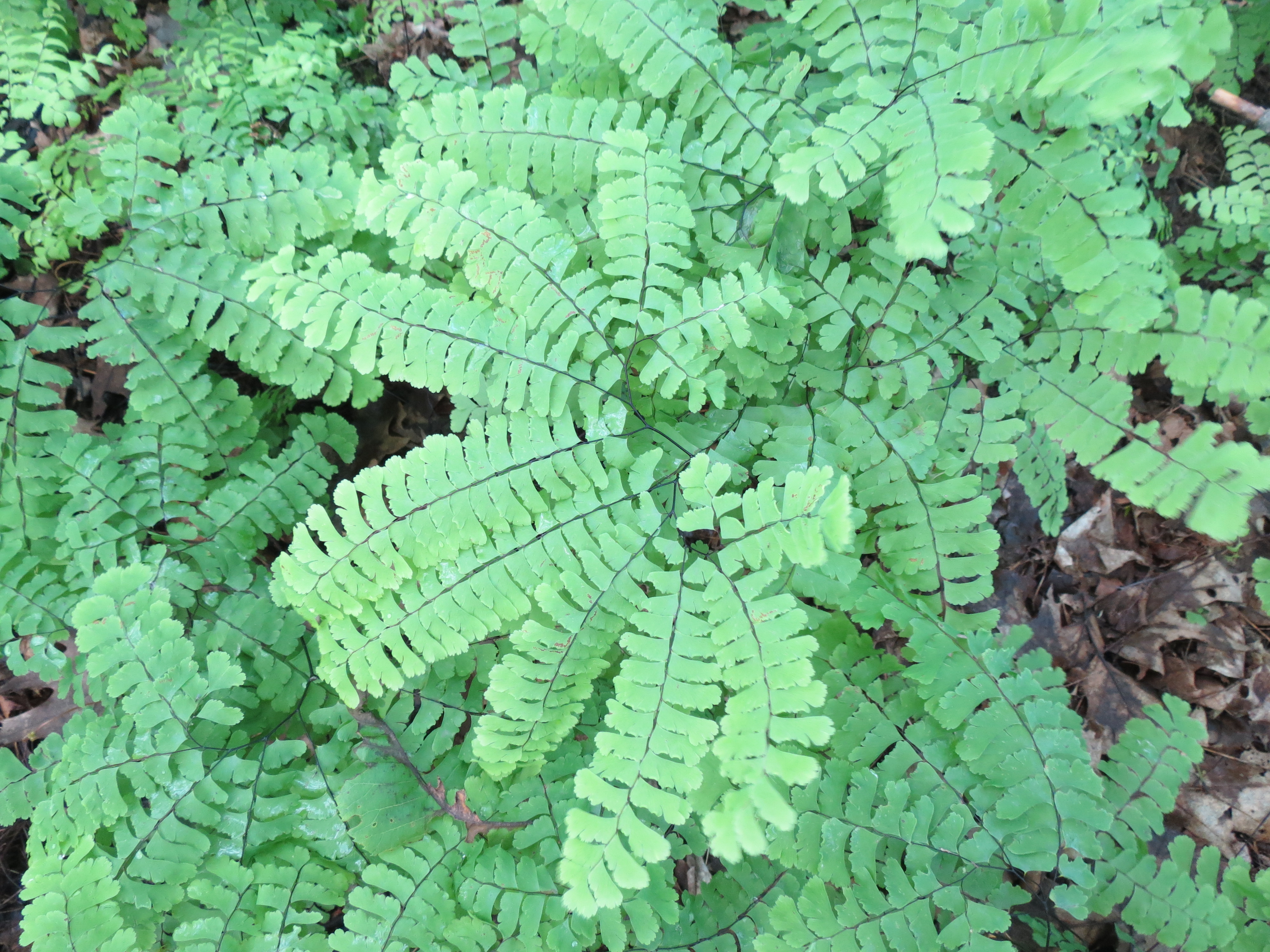
Species of the Week: Northern Maidenhair Fern

Photo by Mark Read

Happy #FernFriday! Our species this week is the Northern Maidenhair Fern (Adiantum pedatum). The name derives from its dark, slender stipes (stalks that connect leaf blades to stems) which resemble wisps of a young woman’s hair. Interestingly, the stipes have been used in basketry as a weaving material. The dark colour creates a nice contrast against cedar roots or sweetgrass, both of which are commonly used in basketry. The fronds (divided leaves) are resistant to rain — appearing dry even after a hard rainfall, and their broad fan-like pattern is unique among native fern species. This delicate perennial is relatively common in the park and can be found on many of the hiking trails and throughout the campgrounds!

Posted in Friends of Murphys Point, Murphys Point, Murphys Point Provincial Park, Species of the Week | Leave a comment