This week’s #SpeciesOfTheWeek is the Twelve-spotted Skimmer (Libellula pulchella). Twelve-spotted Skimmers are large showy dragonflies with a wingspan of about 10cm. When sighted, they often appear larger due to an illusion caused by the 6 alternating white and black spots on each wing (in the case of the male). Twelve-spotted Skimmers are most active in July and August and are very territorial, often patrolling the whole shore of water bodies, such as lakes and ponds. Oftentimes, male Twelve-spotted Skimmers will engage in territorial disputes with other males. These altercations consist of repeating loops around the other male, with the victor being the male that completes a full loop around the other male. The aquatic larvae of Twelve-spotted Skimmers feed on insects such as mosquito larvae, aquatic fly larvae, and freshwater shrimp. They have even been seen catching small fish! As adults, they eat a range of soft-bodied insects, including mosquitos, moths, flies, mayflies, flying ants, and termites. Let us know if you see this or other species of dragonflies in the park!
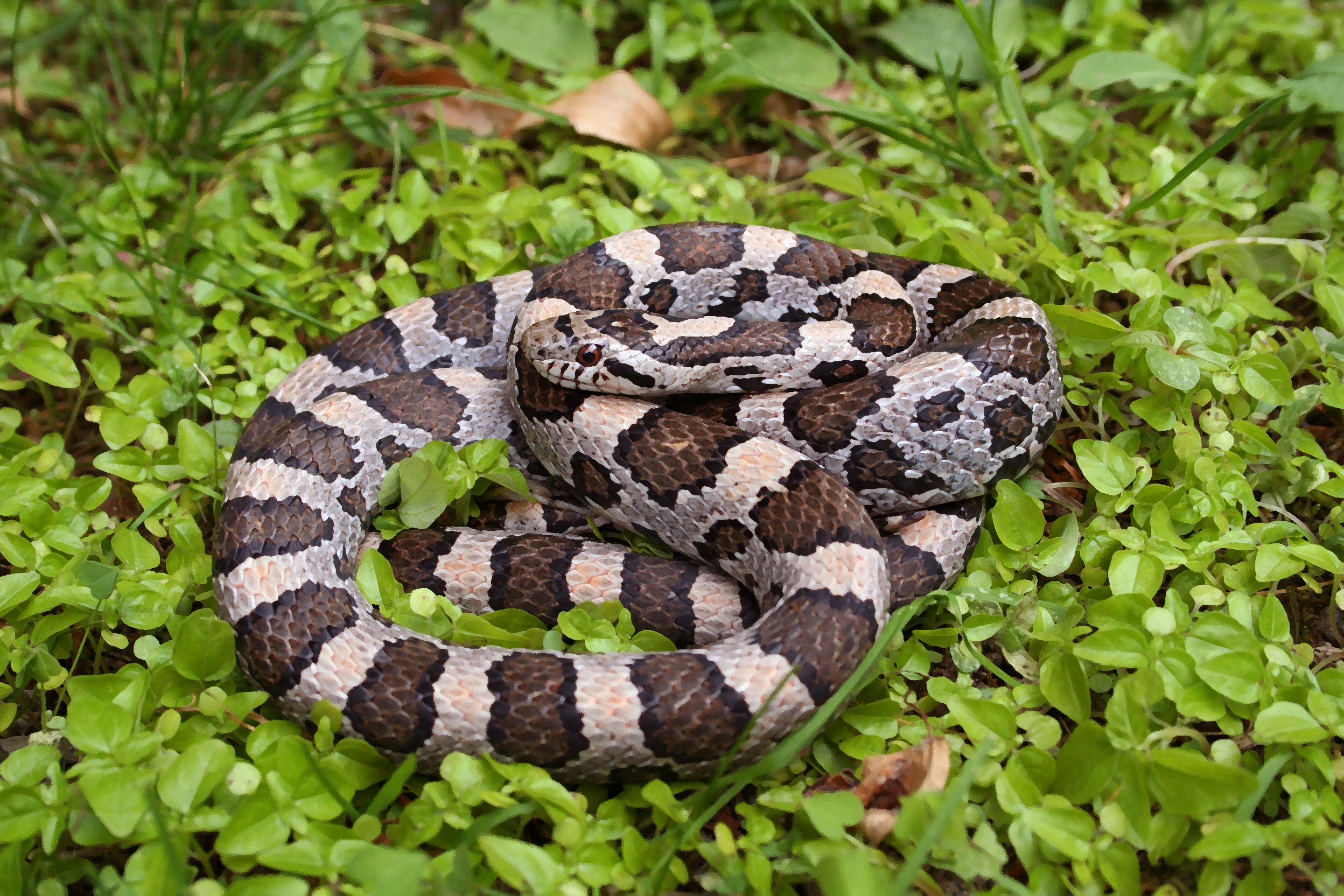
This week’s featured #SpeciesOfTheWeek is the Eastern Milksnake (Lampropeltis triangulum). This species of snake inhabits a wide variety of habitats including rocky outcrops, forests, meadows, and pastures, and can occasionally be found here in the park along the trails or even inside buildings like the McParlan House. As adults, milksnakes typically reach 60-90cm in length, with reddish-brown blotches outlined in black along their beige backs. A little more timid than Grey Ratsnakes, milksnakes will often try to escape when approached, and may even vibrate their tails, hiss, or strike when they feel threatened – though they do not actually have rattles and are non-venomous of course. As you may have wondered, the name “milksnake” comes from an old fable about the snakes sucking cow udders to get milk. While this story is total fiction, as they are physically incapable of such abilities, milksnakes are often found in barns as they enjoy the dark and cool environment, as well as the abundance of rodents that make for a convenient food supply.
The following post is contributed by Friends of Murphys Point student Lazar Stevanovic.
This week we will be taking a closer look at the Perseids Meteor Shower, named after the constellation Perseus. When the shower is at its peak, Perseus is at its highest point in the night sky. This meteor shower lasts from late July to mid-August, reaching its peak on August 11th-12th. When watching the Perseids, the peak of activity occurs in the hours after midnight with 50-80 meteors becoming visible per hour! The Perseids are caused by the Comet 109P/Swift-Tuttle. During its orbit around the sun, it ejects dust and gravel. When the Earth passes the debris, it enters our atmosphere as the meteors.
The Perseids Meteor Shower has special significance in Christianity. The martyrdom of St. Lawrence, known as the “Tears of St. Lawrence,” occurred on August 10th, which coincides with the Perseids. To Christians, the Perseids symbolize the tears of St. Lawrence during his martyrdom. Historical records of the Perseids go back to an even earlier time. Chinese records from 36 A.D. show that the Perseids were even occurring then.
The comet which causes the Perseids was discovered in 1862 by Lewis Swift. This same comet was sighted 3 weeks later by another astronomer, Horace Tuttle. Swift did not announce the discovery of the comet so the comet now bears both of their names (Swift-Tuttle). The orbital period of 109P/Swift-Tuttle is 120 years, with its last near-Earth appearance being in 1992.
Many Indigenous Peoples have stories about comets and asteroids, one of which is the story of Genondahwayanung from the Ojibwa of the Upper Great Lakes. The meaning of Genondahwayanung is “long-tailed heavenly climbing star.” The story speaks of how Genondahwayanung, a star, would return one day to destroy the Earth. It had arrived one day thousands of years ago and burned everything, even rocks. Nothing was left except the Indigenous Peoples, who had covered themselves in mud to protect themselves from the heat. This is just one example of an Indigenous story amongst many about comets.
Frank Hitchens, an amateur astronomer who has led programs at Murphys Point, explained some of the science behind the Perseids Meteor Shower. When asked about how the strength of the Perseids Meteor Shower is measured, he responded: “As the comet called Swift orbits the sun, it leaves a trail of debris behind it and once a year the Earth passes through that trail of debris, and sometimes we pass through areas of that debris that are denser and sometimes areas that are less dense. So, the numbers [of meteors] per hour can differ significantly.” When asked about whether this year’s meteor shower will be stronger than past years, he responded: “All the information I have, it seems to indicate it will be about average, so you’re expecting to see probably 40 to 50 meteors per hour.”
Murphys Point Provincial Park is an excellent place to see the Perseids and we hope you will come and observe this meteor shower in the park!







 Friends of Murphys Point Park