Species of the Week: Big Brown Bat

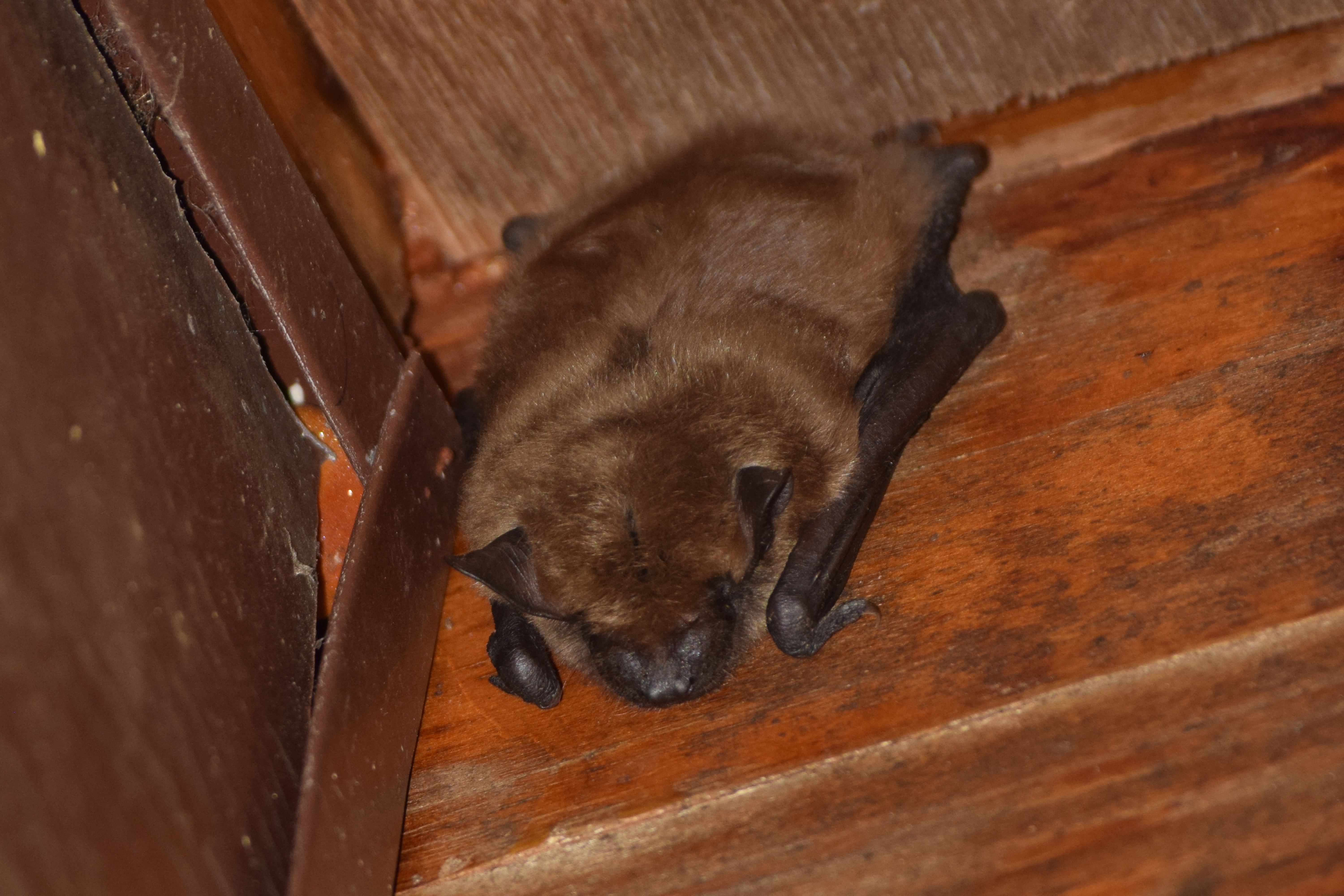
Photo by Adam Kalab

This week our featured #SpeciesOfTheWeek is the Big Brown Bat (Eptesicus fuscus). These nocturnal insectivores use echolocation to feed on things like moths, caddisflies, beetles, and flies. The Big Brown Bat is the most common bat species in Canada and, with a wingspan of up to 40cm, one of the largest. They range from southern Canada to central America and are highly adapted to living in cities where they roost in cavities, buildings and under the bark of trees. Although this species is not threatened, it is still under pressure from human activities such as pesticide use which kills their food source, and from a fungal disease called white-nose syndrome. During the winter, the Big Brown Bat hibernates inside houses, barns, caves, tree cavities or rock crevices; often these sites are located less than 80 km from their summer roosts. This particular bat was sighted at the staff house at Murphys Point. Have you spotted any bats flying around the campgrounds in the evening here at the park?

Posted in Friends of Murphys Point, Murphys Point, Murphys Point Provincial Park, Species of the Week | Leave a comment

Species of the Week: Boreal Oakmoss

Photo by Adam Kalab

This week’s #SpeciesOfTheWeek is a strange-looking lichen. Boreal Oakmoss (Evernia mesomorpha) is a common and widespread lichen in northern boreal and mixed forests. Like all lichens, it is not a single organism, but a mutualistic relationship between algae or cyanobacteria and fungi. Boreal Oakmoss can use any coniferous or deciduous tree as its substrate. While the name suggests oak trees, it has a preference for conifers. It is tolerant of most pollutants, so it can grow near urban areas. Boreal Oakmoss contains usnic acid, which can cause severe dermatitis, so it is recommended to avoid touching it. Its growth form is called fruticose, or shrub-like, with numerous forked, hanging branches. The branches contain the soredia, which are clusters of algal cells wrapped in fungal filaments, and are used for vegetative reproduction. This is a type of asexual reproduction where the soredia break off and are dispersed by wind, then grow into a new lichen after settling on a suitable substrate. Lichens don’t take nutrients from their host substrate, they collect their own water and nutrients from the air. An often overlooked part of the forest, lichens can be remarkable in their shapes and colours. Have you seen any cool lichens in the park?

Posted in Friends of Murphys Point, Murphys Point, Murphys Point Provincial Park, Species of the Week | Leave a comment

Species of the Week: The Black-capped Chickadee

Photo by Nata Culhane

This week’s #SpeciesOfTheWeek is the Black-capped Chickadee (Poecile atricapillus), one of the most common birds in Ontario! These cute little birds have distinct gray bellies, black and white faces and (you guessed it!) black caps on their heads. They have at least 15 different vocalizations, the most recognizable of which sounds like the bird is saying its name (chicka-dee-dee-dee). Chickadees love to eat insects in the summer, and we often see them hanging upside down to get at them. In the winter, they eat mostly seeds and berries and are often seen frequenting bird feeders. They are pretty friendly birds, and will readily eat out of the hand. Black-capped Chickadees also have an astonishingly good memory and can remember the location of food caches for up to 28 days! It has even been found that to prepare for winter, chickadees will add new brain cells to their hippocampus (the part of the brain responsible for memory retention), expanding it by 30%! Come spring, when they don’t need to remember cache locations anymore, the hippocampus shrinks back down to its original size. Chickadees are also well known for their metabolism. Since they don’t migrate in the winter, they have a special cold-weather adaptation. They can lower their internal body temperature by 12 degrees (to around 30°C), entering a state of torpor. They also fluff up their feathers for warmth, and commonly sleep in tree cavities for extra weather protection, sometimes clustering with other chickadees for warmth. In the spring, chickadees form monogamous breeding pairs and build a nest in a tree cavity (often one they built themselves), to get ready for their clutch of 1-13 eggs. Have you seen this bird in the park?

Posted in Friends of Murphys Point, Murphys Point, Murphys Point Provincial Park, Species of the Week | Leave a comment