Species of the Week: The Ghost Pipe

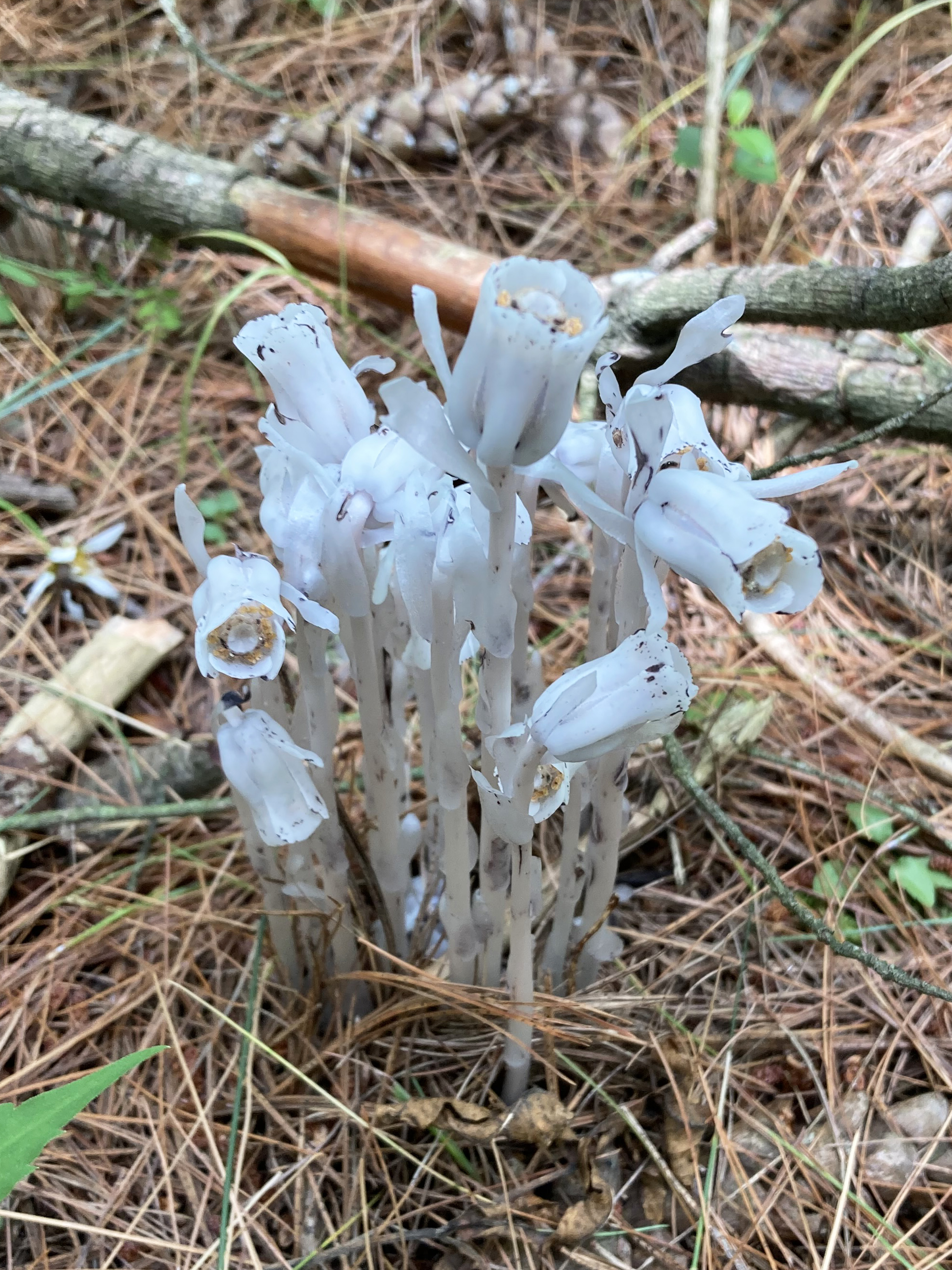
Photo by Adam Kalab

This week’s #SpeciesOfTheWeek is the Ghost Pipe (Monotropa uniflora). With its waxy white colour, it might be mistaken for a mushroom, but it is actually a perennial plant! However, it does not behave like a normal plant. The white colouration of Ghost Pipes comes from their complete lack of chlorophyll, which means they are unable to generate food from photosynthesis. Instead, this plant is a myco-heterotroph, and part of a complex relationship. Most plants have mycorrhizal fungi, which form a network in the roots and allow plants to exchange carbon and nutrients with other plants. Myco-heterotrophs like Ghost Pipe get their nutrients by parasitizing these mycorrhizal fungi. Ghost Pipe has a small range of host fungi, most of which are associated with beech trees. It is usually found in damp, shaded areas of mature forests. Ghost Pipe has a single flower with 3-8 petals, and it usually flowers during the summer and fall, a few days after rainfall. It only appears above ground when it flowers, and the flowering process lasts just one week. When the flower first opens it points downwards, but it straightens as it matures until it is pointing directly upwards. The plant then turns black, which is where its other name, Corpse Plant, comes from. This plant is highly sought after due to its short visible life cycle, perceived rarity, and uses in herbal medicine. However, it may be toxic to humans, so it is best to avoid picking it. Please remember that it is illegal to pick wild plants in a provincial park. If you wish to pick a plant for use in traditional medicine please contact the park naturalist. 

Posted in Friends of Murphys Point, Murphys Point, Murphys Point Provincial Park, Species of the Week | Leave a comment

Species of the Week: European Frog-bit

Photo by Adam Kalab

This week’s #SpeciesOfTheWeek is the European Frog-bit (Hydrocharis morsus-ranae).  European Frog-bit is an aquatic plant native to the old world (Europe, and parts of Asia and Africa). It was brought from Europe to the Experimental Farm in Ottawa in 1932, intending to be used in ornamental ponds. Unfortunately, it escaped and by 1939 was already present in the Rideau Canal. It is now found throughout the Ottawa and Rideau river systems, the Great Lakes, Kawartha Lakes and some American states. European Frog-bit grows rapidly in mats that cover the surface of the water. In the fall it dies and, as it decomposes, it can lead to anoxia (lack of oxygen) in the water. European Frog-bit also reduces the biodiversity of water bodies by crowding native species which hinders their ability to access sunlight and also has a tendency to clog waterways and drainage systems. To counter the spread of European Frog-bit, boaters should reduce their speed when coming near areas infested with European Frog-bit so that the boat’s wake does not dislodge the plant and spread it to new areas. Additionally, boaters should remove any plant that adheres to their boat when moving between bodies of water. At Murphys Point, European Frog-bit has been spotted by the backcountry camping sites on Big Rideau Lake.

Posted in Friends of Murphys Point, Murphys Point, Murphys Point Provincial Park, Species of the Week | Leave a comment

Species of the Week: The Northern Ribbon Snake

Photo by Nata Culhane

Our #SpeciesOfTheWeek is the Northern Ribbon Snake. Often found near marshes, lakes, and ponds, the Northern Ribbon Snake is frequently spotted here at Murphys Point near the Park Store on the shores of Loon Lake. It makes sense that we should find Ribbon Snakes along the water’s edge in this particular spot, since their scientific name (Thamnophis) is derived from the Greek thamnos (shrub or bush) and ophis (snake), and there are plenty of shrubs in this area including Juniper Bushes. Sometimes mistaken for various species of Garter Snakes, the Northern Ribbon Snake is distinguishable by its slender build, its whitish crescent-shaped markings in front of large eyes, and the ‘clean’ look of its striping — colourations that look as though they had been painted onto the snake. This individual was sighted behind the Park Store at Murphys Point.

Posted in Friends of Murphys Point, Murphys Point, Murphys Point Provincial Park, Species of the Week | Leave a comment